Shop By Category

Gallantry and Decorations

A Great War M.C. & Territorial Decoration Group First London (City of London) Brigade RFA

A Great War M.C. & Territorial Decoration Group First London (City of London) Brigade RFA

£1,375.00
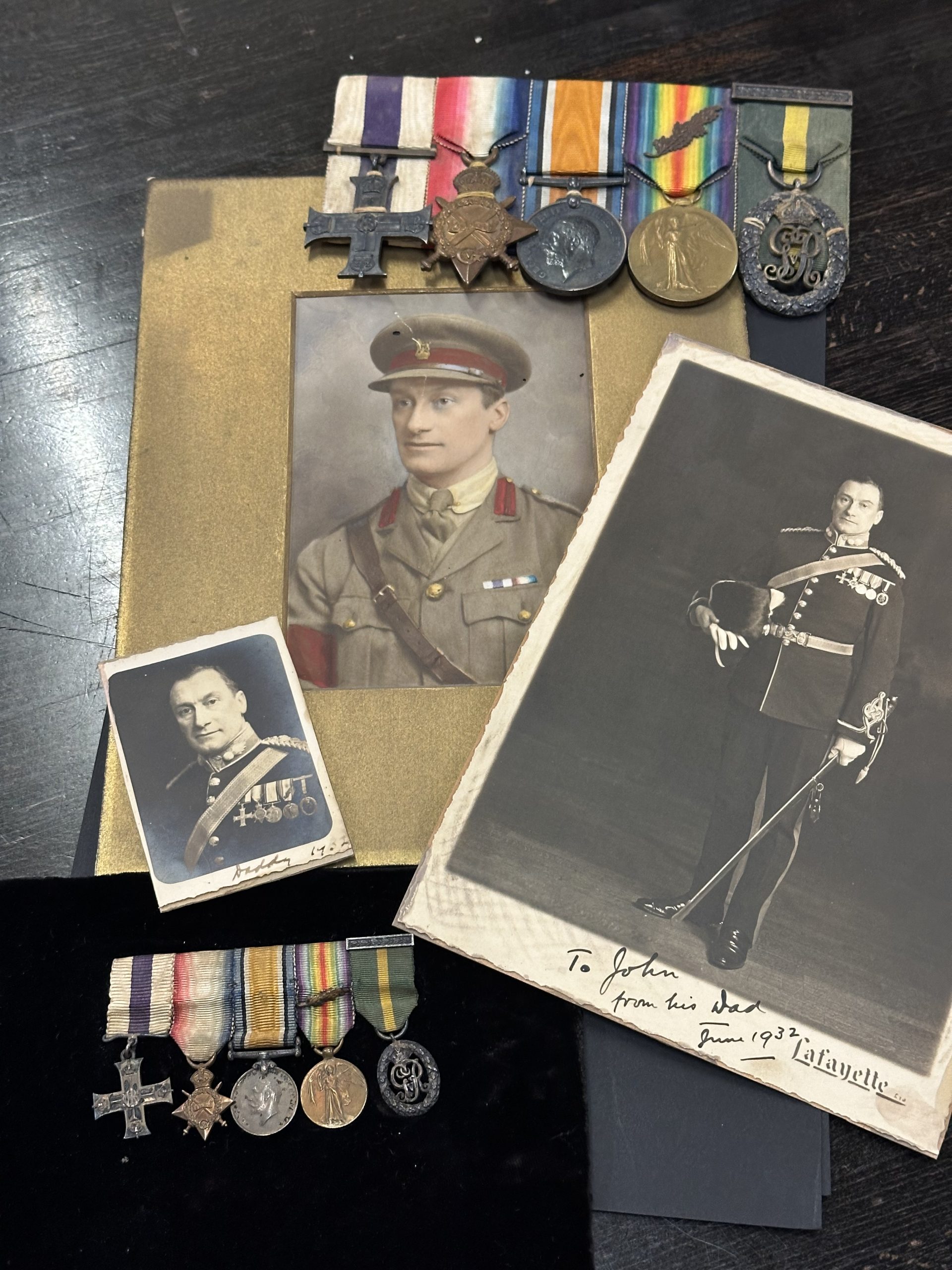
A Great War M.C. & Territorial Decoration Group of 5 awarded to Colonel Henry John Percy Oakley First London (City of London) Brigade Royal Field Artillery Awarded the M.C. in 1917, he later commanded the 90th (City of London) Field Brigade of the Royal Artillery (T.A.) between 1927 and 1933, and was Honorary Colonel of the Brigade jointly with the Lord Mayor after 1938 and into WW2, comprising: Military Cross, G.V.R., unnamed as issued; 1914-15 Star (Lieut. H. J. P. Oakley. R.F.A.); British War and Victory Medals, 1914-1919, the latter with bronze ‘M.i.D.’ spray of oakleaves upon ribbon (Capt. H. J. P. Oakley.); Territorial Decoration, G.V.R., unnamed as issued; Medal court-mounted on bar as worn, with matching set of miniatures, a very good contemporary watercolour portrait of the recipient, in uniform, during the Great War, and a black and white portrait photograph of the recipient, in uniform, c.1926, old dark tone, extremely fine  (12) M.C.: London Gazette: 1 January, 1917 (New Year Honours)T.D.: London Gazette: 5 February, 1926M.i.D.: London Gazette: 20 December, 1918Colonel Henry John Percy Oakley (1878-1942) was born on 22 September 1878 in the City of London. A proud ‘cockney’, he was educated at Birkbeck School, and afterwards joined the North British and Mercantile Insurance Company - where he would in fact remain as an employee for his entire ‘civilian’ career. He was made a fellow of the Institute of Actuaries in 1905, and after an initial period of service as Squadron Quartermaster-Serjeant with the City of London (Rough Riders) Yeomanry, he was appointed Second Lieutenant with the 1st London (City of London) Brigade, Royal Field Artillery on 14 February 1914, just prior to the Great War.Mobilised for service in the Great War, he landed in France and Flanders on 3 October 1915, was promoted to Lieutenant and then received the Military Cross on 1 January 1917. Promoted to Captain on 3 September 1917, he was appointed Staff Captain attached to Headquarter Units on 15 March 1918 (attached to the 40th Division R.A.) in which position he remained until the end of the war.After the war he served on the Council of the Institute of Actuaries almost continuously from 1921 (and was elected President in 1939) but retained his interest in the Territorials. He was promoted to Major with the 90th (City of London) Field Brigade R.A. (T.A.) on 24 June 1921, and was awarded his T.D. on 5 February 1926, after which he was promoted to Lieutenant-Colonel (11 November 1927) and placed in command of his unit between 1927 to 1933. Retiring from this position on completion of his tenure on 1 November 1933, he was appointed as Honorary Colonel of the Brigade jointly with the Lord Mayor after 1938 and early on in WW2, apparently also undertaking duties with the Thames Valley Home Guard by family repute.He continued to be employed by the ‘North British’ in his civilian career, rising to the position of ‘Actuary and Life Manager’ in his latter years. At the time of his death on 3 February 1942, he was Military Member of the Council, and Chairman of the Finance Committee of the City of London Territorial Army Association. See his son's medals Major J.L.D Oakley also available for purchase. Condition as shown in photographs  
A Wounded and then Killed in Action Royal Fusilier Group- also awarded the Military Medal

A Wounded and then Killed in Action Royal Fusilier Group- also awarded the Military Medal

£695.00
-Military Medal George V 1136 Pte. H. Croudace 17th Royal Fusiliers -1914-15 Star numbered E-1136 -War Medal and Victory Medal numbered GS-47864 Henry was born in 1882 at North Wingfield, Derbyshire and before the first World War was a bank Clerk for the Union of London and Smiths Bank. He was Secretary of the local Boy Scout Association, was a member of Mansfield swimming club and sang in the choir of Saint Mark's Church, Mansfield. He enlisted in October 1914 into the Royal Fusiliers and whilst serving with the 17th Empire Battalion, was awarded the Military Medal. London Gazette issue 29701 the 8/8/1916, awarded for 'the Germans blew up a big mine in the British lines and wrecked all the trenches in the vicinity. A sergeant and 2 men scrambled over the wreckage and held the crater for several hours against the enemy until help arrived and the Germans were driven back. Germans put up a strong artillery fire and looked like taking back the crater but failed. All 3 men received the Military Medal' including Croudace. It was awarded for 'Bravery in the field' at Vimy Ridge. It is noted that he was wounded in action at Melville Wood, gunshot wound to the right thigh and appears to have been discharged on 12/9/1916 at Weybridge. He appears to have rejoined the 22nd Btn. Royal Fusiliers and was killed in action 17/2/1917 at Petit Miraumont. He is commemorated at the Thiepval Memorial Pier and Face 8 C 9 A and 16 A. Additional copy paperwork and photograph included with medals. A good opportunity to add a well documented Royal Fusilier gallantry group to your collection. Wounded, awarded the Military Medal and then killed in action. Condition as shown in photographs
HMS Mantua P&O Company Armed Merchant Cruiser WWI DSM Group

HMS Mantua P&O Company Armed Merchant Cruiser WWI DSM Group

£985.00
83466 Chief Leading Fireman George Youngs DSM MMR H.M.S. Mantua -Distinguished Service Medal George V (uncrowned) named G. Youngs CH LG FIRE N MMR. H.M.S. Mantua -1914-15 Star G Youngs FMN MFA -WWI War Medal G Youngs L FMN MFA -Victory Medal G Youngs L FMN MFA Mounted for display in an attractive wood and felt frame. The 1911 census shows George then 29 years old living at 5 Vanguard Street, Deptford with his wife Madeline also 29 years old and their 2 children Amelia and George aged 4 and 2 years respectively. George is recorded as a 'Seaman/Fireman' on the census form. His DSM is recorded in the London Gazette no.30616 as being awarded for service in vessels of the Royal Navy between 1st January and 31st December 1917 whilst serving on H.M.S. Mantua, an armed merchant cruiser. The Mantua was built in 1909 for the P&O Shipping Company for the Australia service. On 5th August 1914 she was requisitioned by the Admiralty for service with the Royal Navy as an armed merchant cruiser. She was converted at Liverpool and fitted with eight 4.7" guns and two 6 pounders and formally commissioned as H.M.S. Mantua into the Royal Navy 15th August 1914. She served initially in the Northern Patrol and then in 1915 as a troop ship. In 1917 she was stationed at Plymouth for duties as a Coastal Patrol and escort vessel between the UK and South Africa. During one of these patrols she was involved in an unfortunate maritime incident with The Quillota, a French, 3 masted sailing ship. On the 24th September 1917 she had sailed from St Nazaire for the Australian port of Freemantle. On 6th October she was sailing along the coast of Portugal in poor weather conditions, the lookout brought to the attention of the Officer of the Watch that he had sighted a large fast-moving steam ship heading directly towards them. In the poor weather conditions he considered it was probably an enemy ship and called his crew to battle stations. Both ships exchanged shell fire and The Quillota sustained damage to her hull and rigging and a fire erupted on the bow. The captain ordered the ship to be abandoned. When the unidentified ship approached the lifeboat the French were astonished to discover it was an armed British merchant cruiser H.M.S. Mantua. Both ships had mistakenly believed each other to be there enemy. The incident had the ingredients of a serious diplomatic fall out between the British and French governments. However the Admiralty acted quickly to smooth over any difficulties accepting that H.M.S. Mantua had sunk the French sailing ship by gun fire mistaking her for a German raider. A court of enquiry was conducted by the Admiralty and French Naval Authorities at Dakar. The findings of the court acknowledged that both captains had made mistakes but the probability that H.M.S. Mantua’s captain was more at fault and a formal apology to the French over the sinking was submitted. During 1918 H.M.S. Mantua continued her war-time duties sailing between Cape Town and Sierra Leone. After the Armistice, she was decommissioned in 1920 and returned to P&O. Continuing her commercial service between the UK and Australia until 1935 when she was decommissioned. Condition as shown in photographs
WWI Military Cross Queen's Westminster Rifles

WWI Military Cross Queen's Westminster Rifles

£995.00
-WWI Military Cross George V unnamed as issued -WWI War Medal named Major P.L. Cockerill -WWI Victory Medal named Major P.L. Cockerill with MID Oakleaf Mounted in attractive felt and wooden frame. Including ribbon bar. Major P.L Cockerill M.C. 2nd Battalion 16th London Regiment Queen's Westminster Rifles. Percy Lawrence Cockerill was born in 1882. The 1891 census recorded the family as living at 40 Howard House in Westminster. He is listed in the London Gazette 12th March 1912 as being appointed as a Lieutenant in the Queen's Westminster Rifles from 20th January (page 1834). He is shown again in London Gazette same rank September 1914. He was promoted to Captain temporarily 3rd October 1914. London Gazette January 1916 shows him with the same rank. Supplement to the London Gazette April 1917 promotes him to temporary Major. Supplement to the London Gazette 21st November 1917 confirms him as being attached to Headquarter units. Confirmed Military Cross awarded London Gazette 1st January 1919. The Times of London 27th June 1919 confirms his appointment to Messrs. Grenfell & Company Stock Brokers from 1st July. After the War he was involved in a high profile divorce case. Egerton v Egerton and Cockerill (before Mr Justice Hill). In an undefended suit, Major V.C. Egerton sued for divorce from his wife Ivy on the grounds of her adultery with Percy Cockerill a Stock Broker (formerly an Officer in the Army.). The Egertons married June 1903. In October 1914 Egerton introduced Cockerill to his wife and invited him to his house. In October 1918 he came home on leave and found his wife seemed worried and cold to him. While he was staying in Southsea with her he found an affectionate letter from Cockerill dated August 1918. His suspicions were aroused and he tied his wife with infidelity. She assured him there was no cause for anxiety but he spoke to Cockerill and demanded an explanation. In which he assured him that their relations were perfectly innocent. In November 1918, he was deployed to Salonika. At some point he received a letter from Cockerill in which he said 'I fully realise how great my sin is...suffering to a man especially to a man, guilty of such a crime which I am not to be considered but one must think of Ivy in this respect. One thing you may be certain of on your return that you will find our lives just as harmless as when you went away.' On his return from Salonika and Palestine, he took his wife and children on holiday to Southsea. During August he was obliged to return to London for a few days and afterwards discovered that Cockerill had taken advantage of his absence to go to Southsea to commit adultery with his wife. At this point he consulted a solicitor. Mr Justice Hill assessed damages at £2000 and he pronounced the Decree Nisi with full costs against Cockerill and Egerton the custody of the 2 children. He ordered that the damages to be paid into court within 14 days. The above details are from the High Court, court minutes, petition filed 28th October 1919, Degree Nici issued 20th May 1920 confirmed 20th November 1920. Egerton had claimed £5000 damages. He appears to have continued to be a Stock Broker until his retirement October 1950. During WWI he served in the 2nd Battalion 16th London Regt. (Queen's Westminster Rifles in the 179th Brigade 2/2nd London division.) The 2/2nd London Division was formed from the Home Service of the Territorial Force. Percy arrived in France on 22nd June 1916 with the rank of captain. His address at the time was recorded as 3 London Wall buildings, London EC2. He was awarded the Military Cross London Gazette 1st January 1919 and was twice mentioned in Dispatches London Gazette 28th November 1917 and 14th June 1918. In civilian life he was a Stock Broker. With copy research and London Gazette entries. Condition as shown in photographs