
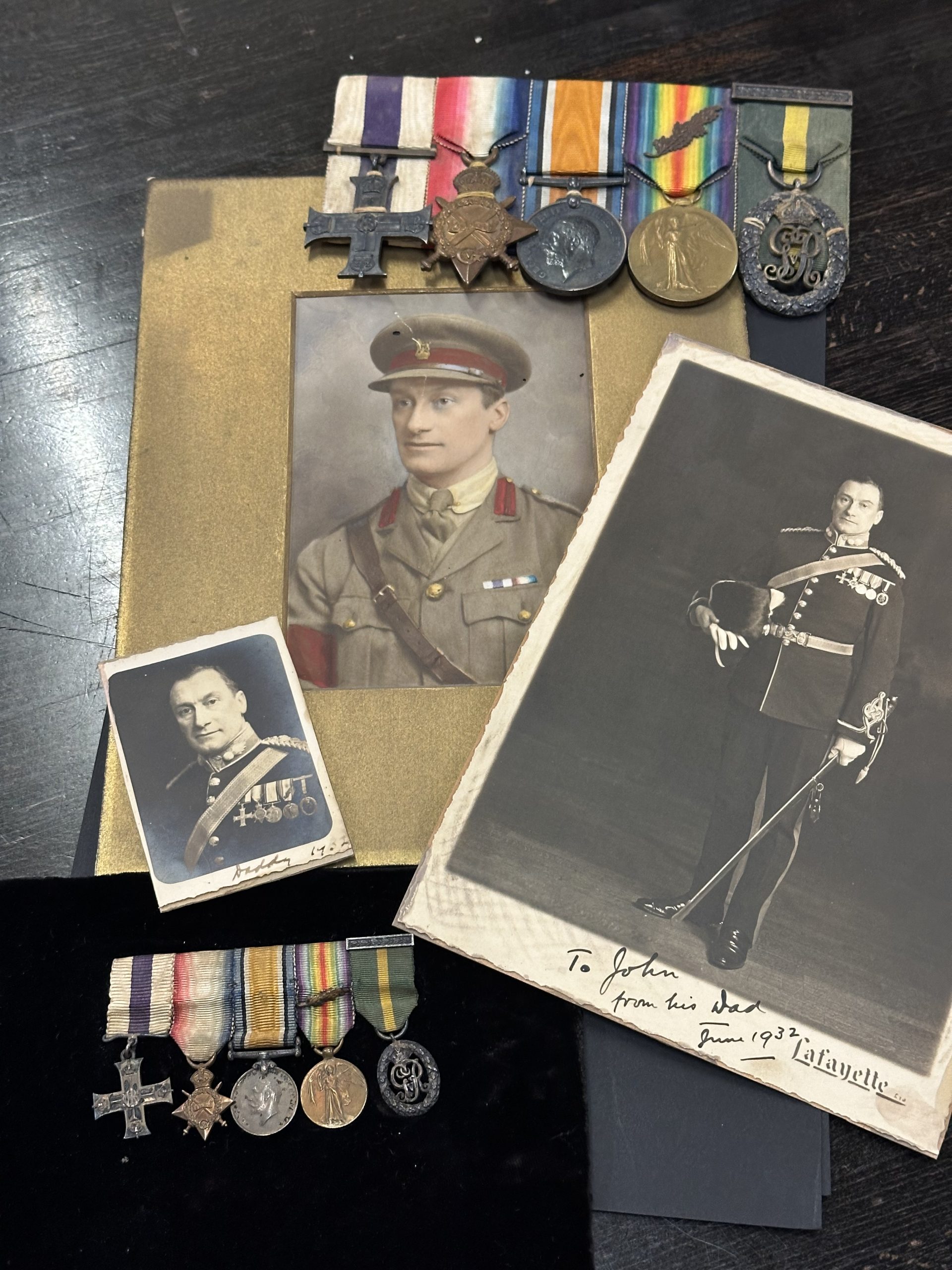
A Great War M.C. & Territorial Decoration Group First London (City of London) Brigade RFA

A Great War M.C. & Territorial Decoration Group First London (City of London) Brigade RFA

1 in stock

£1,375.00

1 in stock

Description

A Great War M.C. & Territorial Decoration Group of 5 awarded to Colonel Henry John Percy Oakley First London (City of London) Brigade Royal Field Artillery

Awarded the M.C. in 1917, he later commanded the 90th (City of London) Field Brigade of the Royal Artillery (T.A.) between 1927 and 1933, and was Honorary Colonel of the Brigade jointly with the Lord Mayor after 1938 and into WW2, comprising: Military Cross, G.V.R., unnamed as issued; 1914-15 Star (Lieut. H. J. P. Oakley. R.F.A.); British War and Victory Medals, 1914-1919, the latter with bronze ‘M.i.D.’ spray of oakleaves upon ribbon (Capt. H. J. P. Oakley.); Territorial Decoration, G.V.R., unnamed as issued; Medal court-mounted on bar as worn, with matching set of miniatures, a very good contemporary watercolour portrait of the recipient, in uniform, during the Great War, and a black and white portrait photograph of the recipient, in uniform, c.1926, old dark tone, extremely fine  (12) M.C.: London Gazette: 1 January, 1917 (New Year Honours)T.D.: London Gazette: 5 February, 1926M.i.D.: London Gazette: 20 December, 1918Colonel Henry John Percy Oakley (1878-1942) was born on 22 September 1878 in the City of London. A proud ‘cockney’, he was educated at Birkbeck School, and afterwards joined the North British and Mercantile Insurance Company – where he would in fact remain as an employee for his entire ‘civilian’ career.

He was made a fellow of the Institute of Actuaries in 1905, and after an initial period of service as Squadron Quartermaster-Serjeant with the City of London (Rough Riders) Yeomanry, he was appointed Second Lieutenant with the 1st London (City of London) Brigade, Royal Field Artillery on 14 February 1914, just prior to the Great War.Mobilised for service in the Great War, he landed in France and Flanders on 3 October 1915, was promoted to Lieutenant and then received the Military Cross on 1 January 1917. Promoted to Captain on 3 September 1917, he was appointed Staff Captain attached to Headquarter Units on 15 March 1918 (attached to the 40th Division R.A.) in which position he remained until the end of the war.After the war he served on the Council of the Institute of Actuaries almost continuously from 1921 (and was elected President in 1939) but retained his interest in the Territorials. He was promoted to Major with the 90th (City of London) Field Brigade R.A. (T.A.) on 24 June 1921, and was awarded his T.D. on 5 February 1926, after which he was promoted to Lieutenant-Colonel (11 November 1927) and placed in command of his unit between 1927 to 1933.

Retiring from this position on completion of his tenure on 1 November 1933, he was appointed as Honorary Colonel of the Brigade jointly with the Lord Mayor after 1938 and early on in WW2, apparently also undertaking duties with the Thames Valley Home Guard by family repute.He continued to be employed by the ‘North British’ in his civilian career, rising to the position of ‘Actuary and Life Manager’ in his latter years. At the time of his death on 3 February 1942, he was Military Member of the Council, and Chairman of the Finance Committee of the City of London Territorial Army Association.


Condition as shown in photographs


A Great War M.C. & Territorial Decoration Group First London (City of London) Brigade RFA

1 in stock

£1,375.00

1 in stock

Description

A Great War M.C. & Territorial Decoration Group of 5 awarded to Colonel Henry John Percy Oakley First London (City of London) Brigade Royal Field Artillery

Awarded the M.C. in 1917, he later commanded the 90th (City of London) Field Brigade of the Royal Artillery (T.A.) between 1927 and 1933, and was Honorary Colonel of the Brigade jointly with the Lord Mayor after 1938 and into WW2, comprising: Military Cross, G.V.R., unnamed as issued; 1914-15 Star (Lieut. H. J. P. Oakley. R.F.A.); British War and Victory Medals, 1914-1919, the latter with bronze ‘M.i.D.’ spray of oakleaves upon ribbon (Capt. H. J. P. Oakley.); Territorial Decoration, G.V.R., unnamed as issued; Medal court-mounted on bar as worn, with matching set of miniatures, a very good contemporary watercolour portrait of the recipient, in uniform, during the Great War, and a black and white portrait photograph of the recipient, in uniform, c.1926, old dark tone, extremely fine  (12) M.C.: London Gazette: 1 January, 1917 (New Year Honours)T.D.: London Gazette: 5 February, 1926M.i.D.: London Gazette: 20 December, 1918Colonel Henry John Percy Oakley (1878-1942) was born on 22 September 1878 in the City of London. A proud ‘cockney’, he was educated at Birkbeck School, and afterwards joined the North British and Mercantile Insurance Company – where he would in fact remain as an employee for his entire ‘civilian’ career.

He was made a fellow of the Institute of Actuaries in 1905, and after an initial period of service as Squadron Quartermaster-Serjeant with the City of London (Rough Riders) Yeomanry, he was appointed Second Lieutenant with the 1st London (City of London) Brigade, Royal Field Artillery on 14 February 1914, just prior to the Great War.Mobilised for service in the Great War, he landed in France and Flanders on 3 October 1915, was promoted to Lieutenant and then received the Military Cross on 1 January 1917. Promoted to Captain on 3 September 1917, he was appointed Staff Captain attached to Headquarter Units on 15 March 1918 (attached to the 40th Division R.A.) in which position he remained until the end of the war.After the war he served on the Council of the Institute of Actuaries almost continuously from 1921 (and was elected President in 1939) but retained his interest in the Territorials. He was promoted to Major with the 90th (City of London) Field Brigade R.A. (T.A.) on 24 June 1921, and was awarded his T.D. on 5 February 1926, after which he was promoted to Lieutenant-Colonel (11 November 1927) and placed in command of his unit between 1927 to 1933.

Retiring from this position on completion of his tenure on 1 November 1933, he was appointed as Honorary Colonel of the Brigade jointly with the Lord Mayor after 1938 and early on in WW2, apparently also undertaking duties with the Thames Valley Home Guard by family repute.He continued to be employed by the ‘North British’ in his civilian career, rising to the position of ‘Actuary and Life Manager’ in his latter years. At the time of his death on 3 February 1942, he was Military Member of the Council, and Chairman of the Finance Committee of the City of London Territorial Army Association.


Condition as shown in photographs